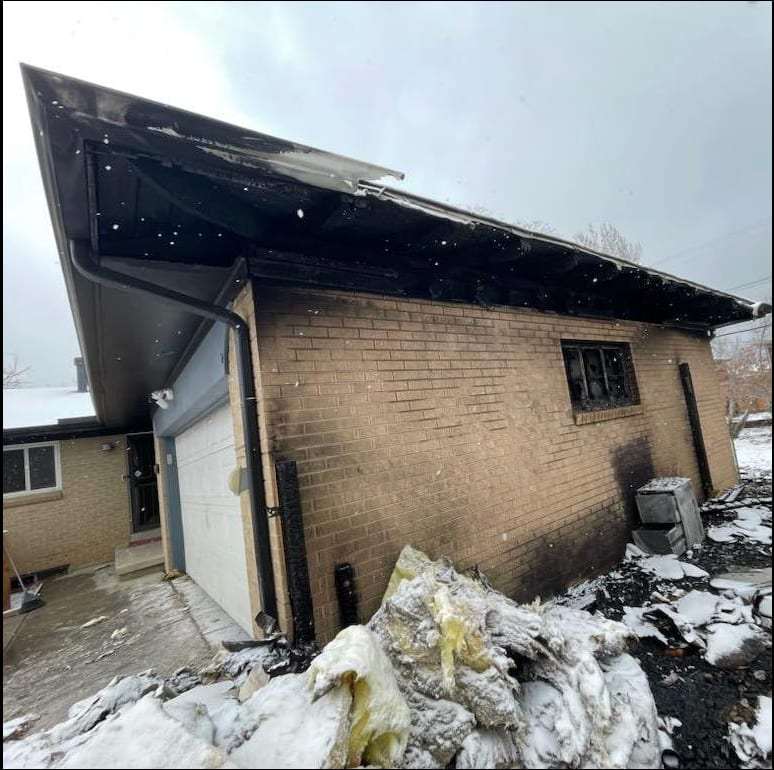
Fire-damaged brick house with debris in the snow. This photo illustrates the topic and is not from any address mentioned on this page.
The situation
Illustrative example. Not a real job or customer.
In this invented example, stored cardboard near a gas furnace in the basement of a 1950s brick ranch catches fire. The household notices smoke from floor registers, gets out and calls 911. The fire is put out in the furnace room, but the furnace blower spread smoke through the ductwork before shutting down. The finished basement, with paneling, a drop ceiling and older floor tile, is smoky throughout.
- Gas is shut off and the furnace is tagged out until a technician inspects it.
- The ductwork is inspected and found to have soot throughout supply and return runs.
- Floor tile and mastic in the basement are sampled before removal.
- Paneling and drop ceiling tiles are removed because they hold smoke odor.
- The upstairs rooms, which have plaster or drywall depending on the room, are cleaned.
- The furnace is replaced and the duct system cleaned before heat is restored.
The basement is rebuilt with new drywall and flooring after abatement of the old tile, the duct system is cleaned and sealed, and the main floor is cleaned rather than rebuilt.
How this differs from an early 1900s house
Postwar ranch
- Forced-air ducts spread smoke quickly
- Finished basements with paneling and drop ceilings
- Floor tile and mastic of the era often need testing
- Simpler roofline and single floor above
Early 1900s house
- Often radiator heat, no ducts to spread smoke
- Unfinished basements more common
- Plaster and paint layers are the main testing concern
- Multiple floors and open cavities carry smoke
Lessons from this example
Common questions
Why replace the furnace if the fire was only near it?
In this example the furnace cabinet, wiring and blower were exposed to heat and soot, and the technician recommended replacement. A furnace close to a fire may be repairable in other cases; an inspection decides, not appearance.
Are paneling and drop ceilings ever cleaned instead of removed?
Lightly affected prefinished paneling can sometimes be cleaned. Ceiling tiles are porous and are usually replaced after heavy smoke. Cost, odor and the age of the materials all influence the choice.
Did the main floor need new walls?
No. Smoke reached it through the registers, but the walls cleaned up well and were sealed and repainted once the ducts were cleaned.
General information for Park Hill, not a quote or professional advice. In an emergency, call 911.